
People and Culture Supporting Value Creation: The Organizational Structure Monex Aims to Build Where People Gather
― First, please tell us about Monex Group's corporate culture.
Yamanaka:Since its inception, Monex Group has valued a culture of respecting different perspectives. This culture did not stem from a deliberate effort to champion “diversity,” but instead grew organically in the company’s early years, within an open environment free from rigid conventions or legacy thinking, allowing a wide range of values to be naturally embraced.
A symbolic example of this is evident in our approach to past M&A activities. Typically, after an acquisition, the acquiring company sends executives and employees to the acquired company to gradually instill its own way of thinking and culture. However, Monex has never actively sought to change the corporate culture or personnel systems of acquired companies. This stems from our commitment to the principle of "respecting what they have done up to now" to avoid diminishing the acquired company's value. This approach extends beyond business contexts to everyday interpersonal relationships. As a result, it feels as though these values were so deeply embedded in the organization that there was no need to consciously emphasize the concept of “diversity.”
This accumulation of practices has likely formed the foundation for Monex's unique culture.
We have also deliberately chosen not to set specific numerical targets for metrics such as the ratio of women in management. This is because we believe that setting numerical targets can create unintended dynamics, potentially undermining the strengths we have built organically over time. Our ideal is an organization in which talented individuals are able to thrive freely and be evaluated fairly, regardless of gender, age, or nationality, etc., with the organization taking shape as a natural result of those evaluations.Today, there is growing demand for the disclosure of data related to women’s participation in the workforce and pay gaps, and we recognize that there are no differences in treatment or compensation based on gender. At the same time, we are aware that the proportion of women in management remains low relative to the overall number of female employees. We therefore recognize that challenges remain in addressing life events—such as childbirth and childcare—that tend to place a disproportionate burden on women.
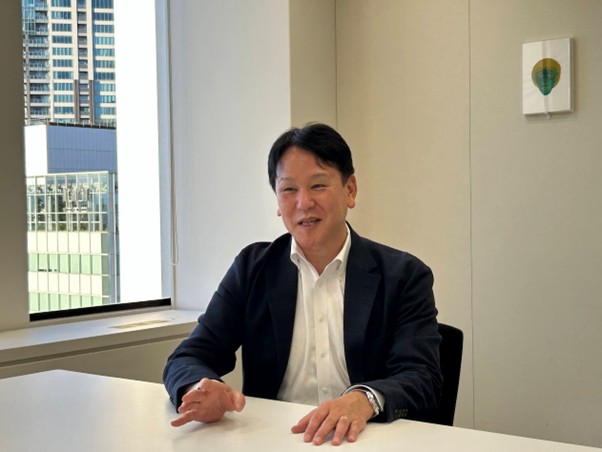
Takuya Yamanaka (Executive Officer, Human Resources, Monex Group)
Connecting Our Philosophy and Values through "Dialogue," Not Just Structures
― Regarding personnel systems, I imagine there have been many trials and errors up to now.
Yamanaka:We have gradually adjusted our HR systems in line with the growth stages of the Monex Group and Monex Securities organizations. Following the first formal articulation of our three action guidelines, the "Core Values," necessary to realize our corporate philosophy in 2023, we now utilize the qualities, aptitudes, and skills required of employees who embody these action guidelines as evaluation criteria.
― How do you think about the relationship between your corporate philosophy and your evaluation systems?
Yamanaka:The Monex Group's corporate philosophy originates from the vision articulated by our founder, Oki Matsumoto: "Just as turning on a faucet provides water, we want information about money and investment to be equally accessible to everyone." I believe this philosophy remains alive and unchanged today. When I first transferred to HR, I considered revising the system to focus evaluation criteria on the corporate philosophy. However, since the last change to the performance evaluation system was relatively recent, we decided to postpone it. We believe the evaluation system is not about formality, but rather the process itself: supervisors and subordinates engage in dialogue to set stretch goals aligned with organizational policies and plans, then confirm growth through trial and error. Therefore, we prioritize creating opportunities for dialogue and designed the system around 1-on-1 meetings.
― Could you explain the unique features of Monex Group's evaluation system?
Yamanaka: What I believe is distinctive to our company is the focus on "For the Team (Team Performance)" as the core evaluation axis. We assess employees' attitude toward maximizing team performance by respecting others' values. This involves each employee demonstrating professionalism and ownership, repeatedly pursuing improvement and challenges, and delivering new value through this process. Furthermore, even if someone experiences multiple failures during trial and error, leading to temporarily lower evaluations, this alone will never hinder their career development. In fact, we have many examples of members who previously received lower evaluations now performing exceptionally well. This culture of genuinely valuing the attitude of improvement and willingness to challenge, rather than the failures themselves, is what defines Monex.
Ownership Fosters Fulfillment
―What changes did you observe after altering the evaluation system?
Yamanaka:This applies specifically to Monex Group and Monex Securities, but as a positive change, our engagement survey launched in 2021 finally showed signs of improvement. Scores improved particularly in areas we had identified as challenges: fulfillment and sense of accomplishment, growth opportunities, clarity of mission and goals, recognition of results, pride in our business and services, and fostering an innovative culture that embraces challenges. We understand this is due to increased dialogue opportunities. This has gradually enabled the experiential learning cycle, where employees apply what they learn through OJT. It has also provided more chances to consider development and career paths. Furthermore, the effects of the business alliance with NTT DOCOMO, announced in October 2023, have started to manifest in practical work. Many employees felt a sense of accomplishment in their assigned tasks.
In addition, starting this fiscal year, we introduced a Productivity Award to encourage goals focused on productivity and efficiency. This initiative coincided with company-wide efforts to adopt AI, and we believe this overlap has contributed to an increase in employees who feel that they have been able to achieve more than expected. The use of AI has clearly improved operational efficiency, allowing employees to spend more time on value creation that can only be delivered by people.
― What attitude do you expect from each employee?
Yamanaka:I believe that a sense of fulfillment is not something that is given to you; it follows from taking ownership and acting with a strong sense of responsibility. There are certainly people who give up because they feel they lack authority, but in such cases, I think it is better to shift toward taking action—by influencing those who do have authority—to realize what you want to achieve. By embracing the mindset of “seeing things through by your own will,” the number of opportunities you encounter increases, and as a result, both outcomes and evaluations can change significantly. I hope people can experience this firsthand and turn it into a source of success and confidence.
Aiming To Be a Company of Choice—For People and For Society
― Finally, could you share the organizational vision Monex aims to achieve going forward?
Yamanaka: Our ideal organization is one in which every employee can pursue self-realization without compromising their own values. We aspire to be a company that is chosen in many contexts, whether for using our group’s services, joining us as an employer, or seeking to pursue collaboration and partnerships with us.To achieve this, we aim to cultivate an organization that encourages challenges, fosters a sense of fulfillment and accomplishment, and enables individuals to thrive by being true to themselves. I believe the role of Human Resources is, through systems and frameworks, to create a highly psychologically safe organization in which growth support and career opportunities are clearly defined, management transparency is ensured, and freedom in decision-making, discretion, and flexible working styles are respected. By doing so, HR helps cultivate an environment and culture that accepts—and even values—challenge and failure.These qualities are essential for becoming a true “company of choice,” and they are also fundamental requirements for innovation-driven organizations. I firmly believe that our group already possesses a strong foundation in these areas. While challenges remain—such as how our group companies can collaborate more effectively to align HR strategies with our growth ambitions—I am confident that each and every employee is committed to creating value in their respective roles.
February 3, 2026
*Employee affiliations, positions, and content reflect information at the time of the interview.
.png)